Friday, September 18, 2015

Erasure and the American Spirit


It struck me today that one constant that ties together the various strands of place-related discourse in U.S. culture, from empire to pastoralism and from John Cotton to Leo Marx, is the process of erasure, whether erasing the past (the idea that America has no history before European conquest, or that America owes no debt to Europe) or erasing entire peoples, both literally and in the public imagination. Many 20th-century ideas about national character or national unity require the erasure of inconvenient people (and their opinions), and certainly our current national attitude toward the environment requires the erasure of many inconvenient truths and results in the literal erasure of animals and ecosystems, a fact itself often erased from public discourse.

As a result, I have modified Gast’s 1872 image of American Progress by replacing Columbia with an eraser. Since Columbia in the picture is so white, and since erasure so often has a racial element, I have chosen the whitest eraser I know, the ubiquitous Staedtler of so many art classes.

Gast, John. American Progress. Chromolithograph, 1872. Prints and Photographs Division, Library of Congress (Photoshop modifications by Ian MacInnes, 2015). 


Thursday, September 17, 2015

Drawing to see at the Art Institute of Chicago


I had a few minutes during our field trip to the Art Institute of Chicago today with the Newberry students, so I sketched a couple of sculptural pieces to see if I could learn anything. Of course, my sketches are kind of crappy, but in both cases the process of drawing let me see the subject in new ways. The griffin head protome is one of my favorite pieces (it’s one of a pair at the entrance to the Greek material). I’ve seen it many times, but in drawing it, I began to notice several things I had never seen before. For one thing, there is a pattern of tiny hatch marks that emphasizes the contour lines along the edges (my drawing only hints at these). There’s also the very faintest spiral on the front of the neck. If it’s what I think it is, I’m going to be excited. I need to come back and look at it more carefully. I also noticed how beautifully balanced the piece is in its s-curve, because I had to re-draw that several times to get it to work.

The other piece is an early Indian sculpture of a rampant lion. His eyes really look like they do in my drawing (!). In drawing the piece I was struck by how beautifully it uses the balance between positive and negative space in its architectural frame. The sturdy linearity of the legs is also complemented by the curvilinear upper form. Is that a fish he’s eating? (yes, he has a mane which I noticed only when drawing). Having to draw the mouth and muzzle drew my attention the mysterious activity there.

I found it interesting that both of the culture that produced these pieces, separated by 1400 years and thousands of miles, seem very interested in the contrast between symmetry/balance and dynamic living tension.

Monday, September 14, 2015

Queen Elizabeth II and Leopold's Congo


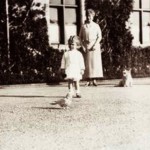
This is an image of the current queen of England as a child in the 1930s chasing a Congolese parrot that had belonged to King George V since the 1880s. The image occurs on a lovely history blog called Wonders & Marvels (this entry is by historian Adrienne Mayor, who wrote a fun recent book on the history of the Amazons).
I thought the image (and the story) connected well with last week’s discussion of Conrad’s Heart of Darkness, which as we noted strikingly underplays non-human animals. George V’s grey parrot, another “product” of the Congo, was a long-lived and articulate creature. Parrots, with their intelligence and ability to speak, challenge the human/non-human boundary in all sort of ways, and they are worth paying attention to. This creature’s lasting presence in the royal court of Britain also helps attest the commodification and coopting of Africa in European culture and mind.

Sunday, September 13, 2015

place and self

In her response to a comment I made on her blog, Allison asks “How about you, what places have shaped your sense of self?”

There are three places that have shaped me, two are houses from my childhood and one is our Michigan farmlet. As you’ll see, I am a child of privilege…

My family home outside Philadelphia was a rambling ivy-covered house with cool lawns and in summer a riot of flowers (my mother was an avid gardener). The house was full of books (we had no TV). My parents did not believe in sending children to lots of scheduled activities, so I ran pretty much wild and spent a lot of time making fires, climbing trees, and playing make believe.

We also had a summer home on an island in Naragansett Bay in Rhode Island, a place with rocky beaches, an archipelago of tiny islands, and cliffs against which the Atlantic swell smashed itself. I spent every summer on the shore or in small boats, mostly by myself or with a friend, fishing, sailing, or beach-combing (once we found a torpedo!), and playing with gunpowder (fire crackers, rockets).

Our old farmhouse in Michigan is cluttered by animals (cats, dogs) and artwork. Perhaps because my wife is an artist, every wall and shelf is covered in art, Indigenous masks, contemporary oil paintings, prints, sculptures, and ceramics. Until recently, it was also filled with adolescent children and their clutter (board games, electronics projects, soccer shoes, origami). Our house has been compared by some to “The Burrow” in Harry Potter.

Thursday, September 10, 2015

If a river runs through it, where is the river?

We had a wonderful presentation for our students today by Jim Akerman, curator of maps at the Newberry. I’m currently working on an article on the representation of the great eastern rivers (Nile, Ganges, etc.) in early modern English poetry, so I’ll admit I’m hyperalert to rivers. Oddly enough, I noticed something in the American atlases that made me think about rivers in a new way. The rational grid system is the hallmark of the development of the American interior in the 19th century, and you can see evidence of it everywhere, including in state boundaries. The only thing really interfering with this (lovely? sinister? disturbingly Cartesian?) platting are the rivers, particularly the big ones like the Missouri and Mississippi, which actually become state boundaries. The planners could ignore many terrain features but apparently not rivers. I think the reason for this is probably economic. For a variety of reasons, rivers complicate the idea of ownership. It’s easier in many ways to treat them as boundaries and separators, a process which avoids the awkward question of where a river “is” or where person is when he or she is on a river. But this process runs counter to an older approach in which the river itself defines the region— the watershed it drains (as it does in the case of the Congo). The result is that rivers are sites of intensified conflict over ownership and control. I’ve seen this to be true back in 16th and 17th century England, but I had not given it the proper notice.

Wednesday, September 9, 2015

Why (some) art historians are evil

Today I spent far too much time finding the right early modern images for an upcoming assignment we’re giving. The problem wasn’t with the images themselves. I knew which images I wanted. I have copies of the images. I've used these images before in teaching. But this time I needed to send students to sources in the Newberry Library that would contain the images in their original context. This should be easy enough with engravings and woodcuts because the majority of them were made to be part of a book, whether as a frontispiece or illustration. What I discovered, however, is that art historians (the ones mostly responsible for commenting on and curating images) are not very interested in which book a woodcut or engraving originally appeared in. With an image in hand, I could easily enough find out the artist and the date (even a completely detached image can be reunited with some details using tineye.com). I could usually find lengthy discussions of the artist, when that was in doubt, as it often is with prints. But even good secondary sources often stopped after citing a print’s artist and date. At least with paintings scholars sometimes will indicate which museum holds the actual painting or whether it is in a (dreaded) “private collection.” But this information is useless for prints. It’s nice to know that a particular library has a copy of a print… carefully cut out of a book which has then been discarded and forgotten at some remote point in the past. So the art historians were my villains this afternoon. My hero? 19th-century antiquarians. These are the people who could spend years meticulously cataloguing the original provenance of every print in a certain genre, including copying out every inscription and noting every variant. My other hero, my enabler, my friar Lawrence, was Google Books, through whom 19th-century historians live again in all their public-domain-and-copyright-free glory.

Monday, September 7, 2015

Beginnings

So it turns out that my original "research blog" has become public enough that I am reluctant to post small daily comments. Happily, my class at the Newberry Library has given me the excuse to restart a more informal blog. I took the title from Paradise Lost, my favorite poem.
I was excited to find that the Newberry has a copy of an engraving we'll be using in class this week. It's in a volume called Nova Reperta along with several other marvelous images. No copy of the engraving available on the Internet comes near to the quality of the original, and many details are suddenly clear.