Wednesday, October 21, 2015

Mapping Herefordshire

Moving slowly along. I spent a little time going over the Herefordshire page in Speed’s 1612 Atlas with a magnifying glass. One thing that struck me more obviously with the paper version in front of me is the extent to which the rivers are emphasized, even small ones.
This is consistent with arguments I’ve made (and am busy expanding elsewhere) about the depiction of rivers in English poetry of the period. Apart from the standard items (towns, bridges, rivers, hills - loosely represented), the map of Herefordshire makes special note of only two features: the “Gilden Vale” (it’s the river Dore) and Marcley Hill (see my post on the travelling hill). Strikingly, New Court on the Dore, is outlined as a major site. Today nothing remains of New Court except a place labled on the most detailed Ordnance Survey map as “New Ct. Farm.” My sources tell me the building on that site is new. On the other hand, the current Ordnance Survey map still locates the site of the 1571/5 landslip as “The Wonder.” Here is Speed compared to the OS map.


Wednesday, October 14, 2015

Lurid Agriculture

As part of this MLA paper I’m working on, I’m revisiting Rowland Vaughan’s treatise on water meadows, an early modern form of irrigation which he invented. This might not sound exciting, but listen to the language of one of the prefatory poems, written by John Davies. Thanks to Vaughan’s agricultural innovation, he
holds the Sperme of Herbage by a Spring)
Infuseth in the wombe of sterile Lands,
The Liquid seede that makes them Plenty bring.
…
For, as all Womens wombes do barren seeme,
That neuer had societie of Men;
So fertill Grounds we often barren deeme,
Whose Bowells, Water fills not now and then.1
It’s not surprising to see the landscape gendered like this (there’s a long tradition of this going back to the classical period), but it’s rare to see the point made so explicitly. I’m still thinking about what to do with passages like this.
  1. Rowland Vaughan and John Davies, Most Approued, and Long Experienced Water-Workes, London, 1610. ↩︎

Tuesday, October 13, 2015

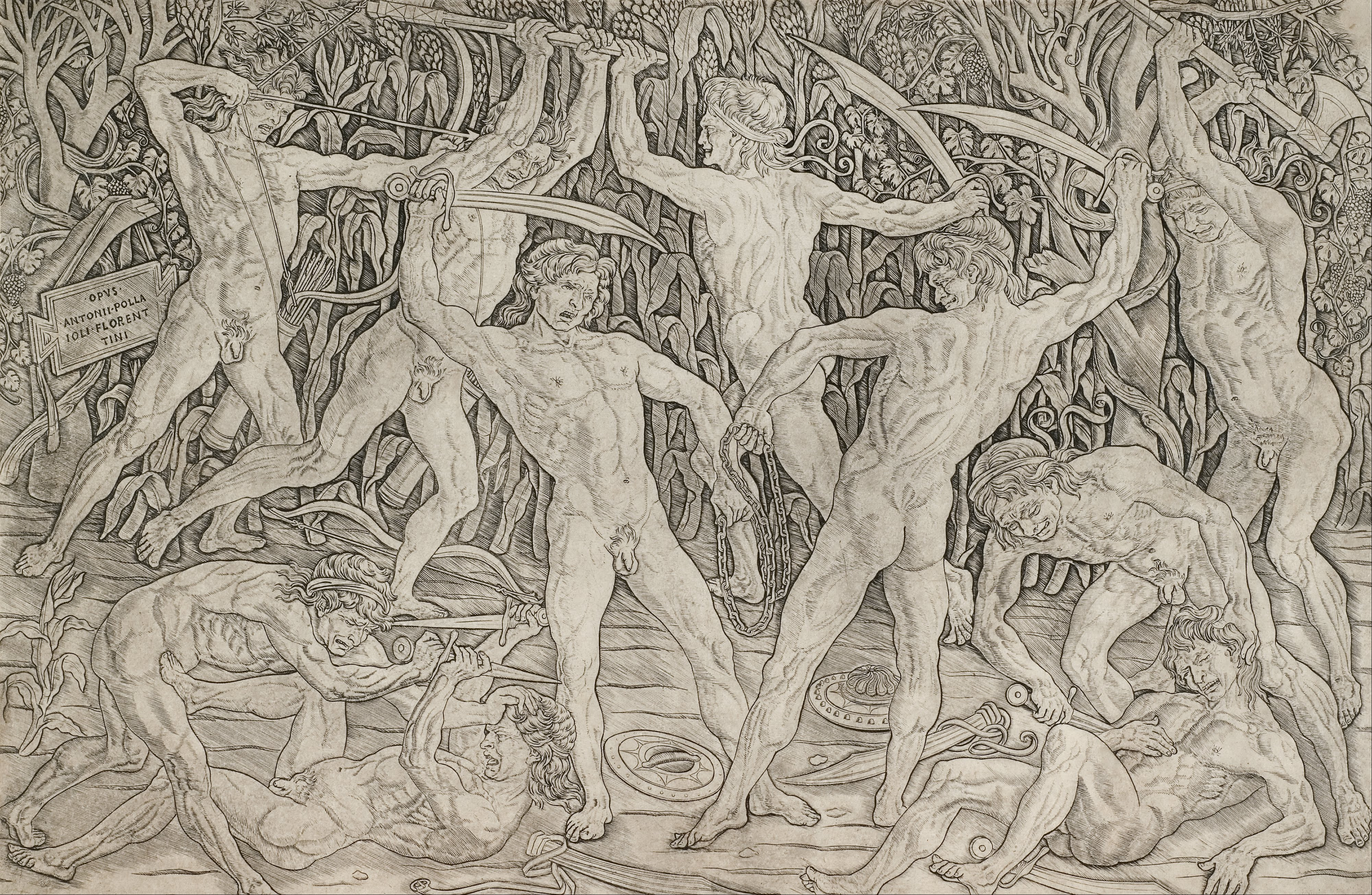
Thinking about Pollaiulo’s *Battle of the Nudes* in the Art Institute

I’ve always been fascinated by Pollaiulo’s Battle of the Nudes because art historians seem unable to figure out what it’s about. Some have tried to argue for a particular classical source based on iconography or similarities to other works. Others have rejected specificity, arguing that the painting is either a stylistic exercise in the nude figure in action or that its content is moral (in a general sense).1 Since the print is unique, however, attempts to close it down have been unconvincing. This is fine by me.
The other day I encountered the print again in the Art Institute of Chicago, this time in a wonderful exhibit on Dionysos that matched early modern prints with classical objects. Next to the print is a classical statue of a group of satyrs fighting a snake (acquired by the Art Institute in 2010, I think); the placard notes that it has been suggested that Pollaiuolo drew on this statue in creating the print. This argument dates back to Laurie Fusco’s 1984 article 2, and indeed there are some remarkable similarities between at least one of the satyrs and the print.

Some of those similarities have to do with the position of the middle satyr, but the faces of the satyrs are also markedly similar to the faces in Pollaiuolo’s print. In moving back and forth from the classical sculpture to the print, I began to consider more carefully something I think everybody notices: the similarity between the all the faces in the print. This similarity is certainly noticed by those new to the print 3, but it is not something art historians have paid much attention to, probably because there are so many other examples of early art in which individual faces are rendered using a generic pattern. I began to wonder, however, whether in this case that process is not responsible for the similarity between the faces and whether Pollaiulo is deliberately portraying a battle between one person.
The most important evidence in favor of this hypothesis is that the faces in Pollaiulo’s print are hardly generic They are highly marked with distinctive features. If we look at an example of a piece in which the generic principle is at work, such as Michelangelo’s Battle of Cascina, we can see the difference. The faces in Michelangelo’s engraving are generic in the ordinary sense, with average undistinguished features.

Even here, however, Michelangelo has introduced external details (facial hair, clothing) that while not truly individualizing the characters at least prevent us from thinking they are the same person. Pollaiulo’s faces, on the other hand, have not only the same features but the same hairstyle and the same hair band, and those details are carefully recorded. If there is a template at work, it might be the classical satyr-face, but even here the similarities exceed the reach of the genre.

If the figures are deliberately representing one individual, then the engraving as a whole clearly has a moralizing focus on internal conflict. This is not an alien idea to Renaissance art and literature. There is a long tradition of representing the individual allegorically, a tradition dating back to Prudentius’ Psychomachia and extending forward to the medieval morality plays. It’s a tradition that is reflected in Renaissance emblem books, too, and the mysterious chain in the middle of the picture might work in those terms. But this post has gone on long enough.
  1. See Jay A. Levenson, et al., Early Italian Engravings from the National Gallery of Art (National Gallery of Art, 1973) 66-80. Also,
    Joseph Manca, “Passion and Primitivism in Antonio Pollaiuolo’s Battle of Naked Men.,” Notes in the History of Art 20, no. 3 (2001): 28–36. ↩
  2. Fusco, Laurie. “Pollaiuolo’s Battle of the Nudes : A Suggestion for an Ancient Source and a New Dating.” In Scritti Di Storia Dell’arte in Onore Di Federico Zeri, 1:196–99. Milan & Los Angeles, 1984. ↩︎
  3. Kyle. “Art 236: Post #3 - Formal Analysis.” Art 236, January 18, 2012. http://kyleg235.blogspot.com/2012/01/post-3-formal-analysis.html. ↩︎

Thursday, October 1, 2015

A Traveling Hill

I’m trying to enrich my understanding of an event in Herefordshire in the late 16th century. Here’s what happened, according to John Speed and William Camden’s Theater of the Empire of Great Britaine:
But more admirable was the worke of the Omnipotent even in our owne remembrances, and yeere of Christ Iesus 1571. When the Marcley Hill in the East of this Shire rouzed it selfe out of a dead sleepe, with a roaring noise removed from the place where it stood, and for three daies together travelled from her first site, to the great amazement and feare of the beholders. It began to journey upon the seventh day of February, being Saturday, at six of the clocke at night, and by seven in the next morning had gone fortie Pases, carrying with it Sheepe in their coates, hedge-rowes, and trees; whereof some were overturned, and some that stood upon the Plaine, are firmely growing upon the Hill, those that were East, were turned West; and those in the West were set in the East: in which remove it overthrew Kinnaston Chappell, and turned two high-wales neere a hundred yards from their usuall paths formerly trod. The ground thus travelling, was about twenty six Acres, which opening it selfe with Rocks and all, bare the Earth before it for foure hundred yards space without any stay, leaving that which was Pasturage in place of the Tillage, and the Tillage overspread with Pasturage. Lastly, overwhelming her lower parts, mounted to an hill of twelue fadomes high, and there rested herselfe after three daies travell.(1)
The note in this copy indicates that most of the text comes from Camden’s Britannia, but the earliest editions of this work (in Latin) do not contain a reference to the event, so I’m guessing this is all John Speed’s addition. The date is also a little uncertain. Some (much) later references to this event say it happened in 1575, and one says it occurred on February 17. All, however, seem to be derived from Speed’s account in 1612. Yet Speed himself calls the date “Saturday” in one edition and “Sunday” in another. February 7, 1571 was a Wednesday (ecclesiastical year) or a Tuesday (legal year) according to the historical calendar app I wrote, which is always right. I’m hoping to find some ephemera at the Newberry Library, not indexed in EEBO, that can help clarify the source.

And why, you might ask, is it relevant? Well, first of all Hereford is held up as an epitome of England’s pastoral countryside. As Speed and Camden put it,
No place in England yeeldeth more, or better conditioned: sweet rivers running as veines in the body, doe make the corne-bearing grounds in some of her parts rightly to be termed the Gilden Vale: and for waters, wooll, and wheat, doth contend with Nilus, Colchose, and Egypt: such are Lemster and Irchenfeild, the banks of Wye, Luge, and Frome.(2)
That means that landscape descriptions for Hereford are particularly important in understanding attitudes toward the environment in England more widely. Second, the language of the passage, which literally animates the landscape, is bizarre, as is the concentration of agricultural images: pasturage, tillage, sheep, etc. This feels to me like language originating from near the source. Finally, Hereford was also the site of rapid environmental change in the agricultural landscape, a change sometimes contested even in terms of the relative proportions of tillage and pasturage. This event is oddly contiguous with that environmental change.

  1. John Speed and William Camden, The Theatre of the Empire of Great Britaine Presenting an Exact Geography of the Kingdomes of England, Scotland, Ireland, and the Iles Adioyning: With the Shires, Hundreds, Cities and Shire-Townes, within Ye Kingdome of England, Divided and Described by Iohn Speed. (London, 1612). p. 49.
  2. Ibid.