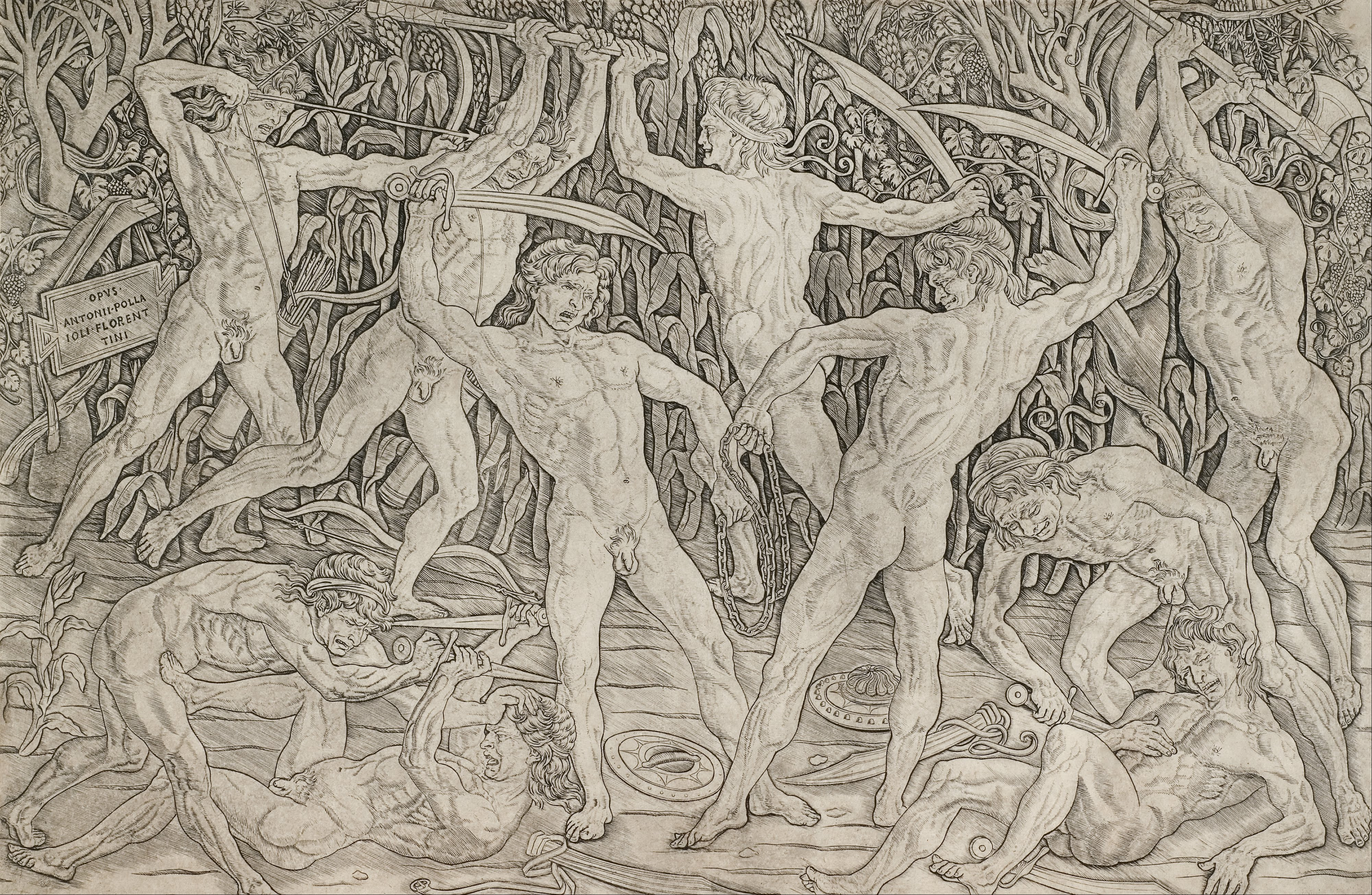
The other day I encountered the print again in the Art Institute of Chicago, this time in a wonderful exhibit on Dionysos that matched early modern prints with classical objects. Next to the print is a classical statue of a group of satyrs fighting a snake (acquired by the Art Institute in 2010, I think); the placard notes that it has been suggested that Pollaiuolo drew on this statue in creating the print. This argument dates back to Laurie Fusco’s 1984 article 2, and indeed there are some remarkable similarities between at least one of the satyrs and the print.

Some of those similarities have to do with the position of the middle satyr, but the faces of the satyrs are also markedly similar to the faces in Pollaiuolo’s print. In moving back and forth from the classical sculpture to the print, I began to consider more carefully something I think everybody notices: the similarity between the all the faces in the print. This similarity is certainly noticed by those new to the print 3, but it is not something art historians have paid much attention to, probably because there are so many other examples of early art in which individual faces are rendered using a generic pattern. I began to wonder, however, whether in this case that process is not responsible for the similarity between the faces and whether Pollaiulo is deliberately portraying a battle between one person.
The most important evidence in favor of this hypothesis is that the faces in Pollaiulo’s print are hardly generic They are highly marked with distinctive features. If we look at an example of a piece in which the generic principle is at work, such as Michelangelo’s Battle of Cascina, we can see the difference. The faces in Michelangelo’s engraving are generic in the ordinary sense, with average undistinguished features.

Even here, however, Michelangelo has introduced external details (facial hair, clothing) that while not truly individualizing the characters at least prevent us from thinking they are the same person. Pollaiulo’s faces, on the other hand, have not only the same features but the same hairstyle and the same hair band, and those details are carefully recorded.
 If there is a template at work, it might be the classical satyr-face, but even here the similarities exceed the reach of the genre.
If the figures are deliberately representing one individual, then the engraving as a whole clearly has a moralizing focus on internal conflict. This is not an alien idea to Renaissance art and literature. There is a long tradition of representing the individual allegorically, a tradition dating back to Prudentius’ Psychomachia and extending forward to the medieval morality plays. It’s a tradition that is reflected in Renaissance emblem books, too, and the mysterious chain in the middle of the picture might work in those terms. But this post has gone on long enough.
- See Jay A. Levenson, et al., Early Italian Engravings from the National Gallery of Art (National Gallery of Art, 1973) 66-80. Also,
Joseph Manca, “Passion and Primitivism in Antonio Pollaiuolo’s Battle of Naked Men.,” Notes in the History of Art 20, no. 3 (2001): 28–36. ↩
- Fusco, Laurie. “Pollaiuolo’s Battle of the Nudes : A Suggestion for an Ancient Source and a New Dating.” In Scritti Di Storia Dell’arte in Onore Di Federico Zeri, 1:196–99. Milan & Los Angeles, 1984. ↩︎
- Kyle. “Art 236: Post #3 - Formal Analysis.” Art 236, January 18, 2012. http://kyleg235.blogspot.com/2012/01/post-3-formal-analysis.html. ↩︎

No comments:
Post a Comment